By: Emergency Technical Decon Team
A complete structural firefighting ensemble often weighs about 45 to 75 pounds once turnout clothing, helmet, boots, gloves, hood, self-contained breathing apparatus (SCBA), and basic tools are added together. Some setups land below that range and some go above it, especially when firefighters carry forcible-entry tools, hose packs, saws, or rescue equipment. Exact weight varies by manufacturer, firefighter size, department configuration, and air-cylinder type.
That matters because firefighter gear weight is not just a number on a scale. It affects mobility, balance, stair climbing, heat stress, fatigue, and how long a firefighter can work efficiently in a demanding environment. The point is not to criticize protective equipment. The point is to understand the load so departments can train for it, fit it correctly, maintain it properly, and make sound decisions about gear care over time.
Firefighter Gear Weight at a Glance
A practical way to answer the question is to look at the common pieces one by one. These are working ranges for structural firefighting ensembles, and they should be treated as approximations rather than fixed standards.
- Turnout coat and pants: about 15 to 25 pounds
- Helmet: about 3 to 5 pounds
- Boots: about 5 to 8 pounds per pair
- Gloves and hood: about 1 to 3 pounds combined
- SCBA or air pack: about 20 to 30 pounds depending on cylinder size and configuration
- Radio, flashlight, webbing, and small essentials: about 2 to 6 pounds
- Optional tools or specialized equipment: can add 5 to 35 pounds or more
Departments that review gear history, construction, and design changes over time can also compare how older and newer ensembles evolved in fit and load distribution in the history of bunker gear.
What Makes Up the Weight of Firefighter Gear?
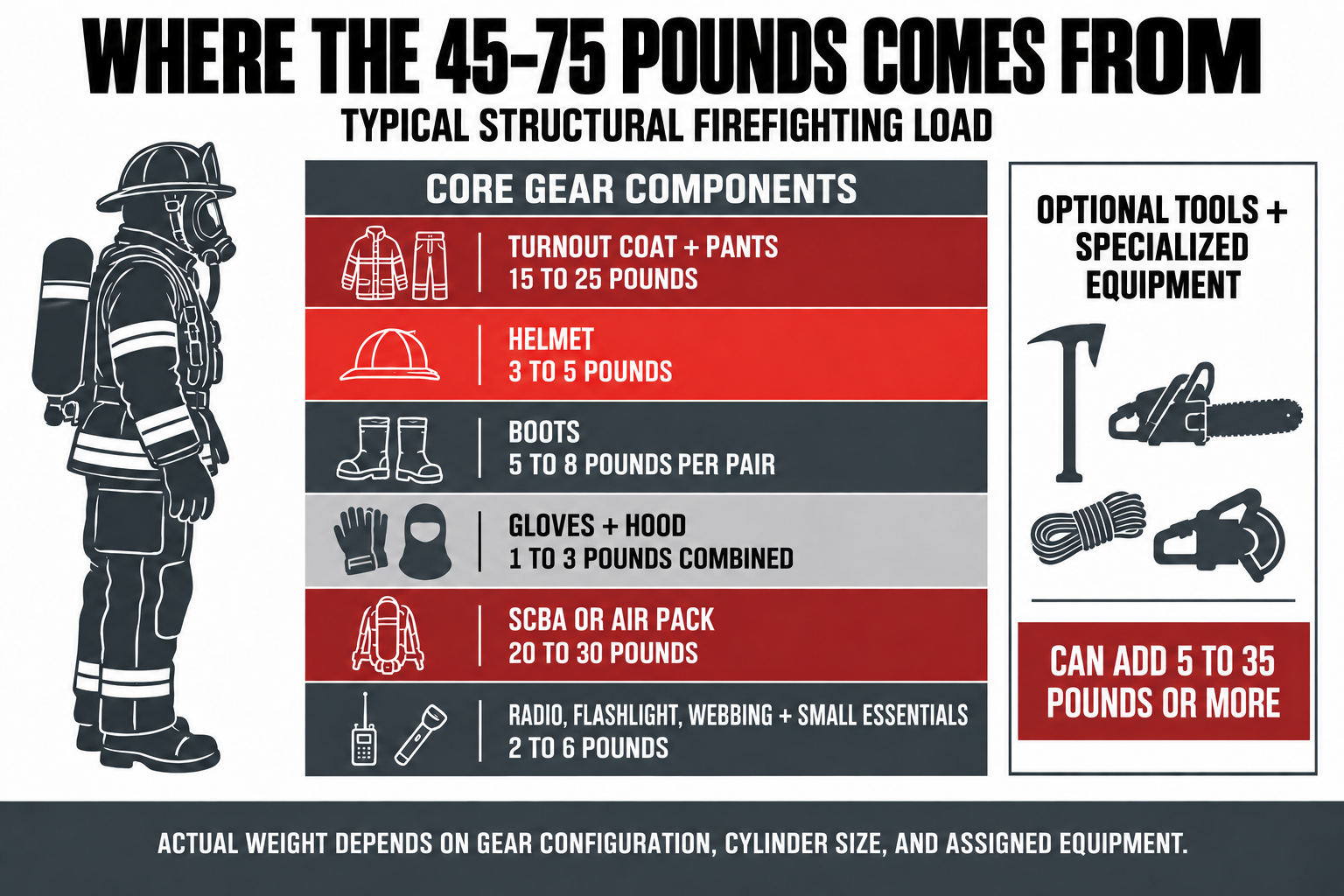
Firefighter gear weight includes the protective ensemble, SCBA, small essentials, and any additional tools assigned. Total weight varies with gear configuration, cylinder size, and assigned equipment.
Think of the total load as a stacked system rather than one heavy item. The SCBA is usually the single biggest contributor, followed by the turnout coat and pants, then boots and helmet, with smaller accessories adding up quickly.
A firefighter may only notice each item a little at a time while gearing up, but the combined load can reach the equivalent of carrying a large weighted pack while climbing stairs, crawling, advancing hose, and working in heat.
Weight Breakdown by Piece of Equipment
The turnout coat and pants make up a large part of the load because they combine outer shell materials, moisture barriers, thermal liners, trim, hardware, reinforcements, and closures. Their job is protection first. That means weight can differ noticeably by size, layering, cut, and reinforcement package.
Helmet weight can feel more important than the raw number suggests because it sits high on the body. Even a few pounds carried on the head and neck can affect balance, posture, and how tiring prolonged work feels, especially during overhead tasks or long incidents.
Boots also matter beyond their listed weight. Weight at the feet can increase the effort of walking, climbing, kneeling, and stepping over obstacles. Stiffness, sole construction, and fit can change how heavy boots feel during a long operation.
Gloves and hoods are lighter than the major pieces, but they still contribute to the full burden of structural PPE. They affect heat retention, dexterity, hand fatigue, and the way the ensemble seals around the wrists, neck, and facepiece interface.
The SCBA is often the heaviest single component in the system. Once the harness, frame, cylinder, regulator, and related hardware are included, the pack changes posture, center of gravity, and work rate. That is one reason firefighters train specifically in full PPE and air rather than treating the air pack as a minor add-on.
Small items can be easy to overlook when discussing firefighter PPE weight. A portable radio, flashlight, door chocks, webbing, cutters, or a thermal imaging camera may each seem manageable, but together they can add several more pounds. They also tend to be carried off-center or in pockets, which can change movement quality even when the scale increase seems modest.
How Weight Changes by Firefighter Role and Call Type
A firefighter’s actual load changes by assignment. An engine company member advancing hose may have a different carried load than a truck company member forcing entry, throwing ladders, or opening a roof. Rescue teams can add rope, medical, or extrication equipment. Hazmat operations may involve different garments and accessories altogether.
Wildland firefighters usually operate in lighter ensembles than structural interior crews because the hazard profile, work duration, and mobility demands are different. Structural firefighting PPE is built for a different protection problem, so it commonly comes with a higher base weight and greater heat burden.
Call type matters too. A short room-and-contents response, a high-rise stair climb, an extended overhaul, and a technical rescue can all change how much gear is worn or carried and how demanding that same weight feels over time.
Dry Gear vs. Wet Gear: Why It Can Feel Much Heavier
Gear can gain weight when it takes on water, sweat, and contaminants. Even when the measurable increase is not dramatic for every item, wet gear usually feels harder to move in. Moisture changes the way garments hang, flex, and trap heat, and it can make the whole ensemble feel stiffer and more exhausting.
That is one reason departments pay close attention to cleaning, drying, and condition over the life of the ensemble. Moisture management is tied not only to comfort, but also to readiness and long-term care. ETD discusses those care issues in turnout gear temperature limits and ratings, where heat exposure and material performance are part of the same operational picture.
From the firefighter’s point of view, wet gear often means a compounded workload: more drag, more heat retention, more friction, and more fatigue. So even if the scale only tells part of the story, the field effect can be much more noticeable.
Why Firefighter Gear Weight Matters
Protective equipment is essential, but load has consequences. More weight can reduce agility in tight spaces, slow transitions from standing to kneeling or crawling, and make slips or missteps more likely on stairs and uneven surfaces. Added weight high on the body or across the back can also influence balance.
Weight and heat work together. Structural PPE limits heat transfer from the outside in, but it also makes it harder for the body to shed metabolic heat during hard work. Add an SCBA, a hot environment, and sustained exertion, and the overall burden rises quickly.
There is also an air-consumption angle. Harder work usually means faster breathing, and faster breathing can shorten useful cylinder time. That does not mean weight alone determines air use, but it is clearly part of the workload equation alongside fitness, task intensity, terrain, and heat.
Understanding firefighter gear weight helps departments make better decisions about fit, sizing, rehab, rotation, physical preparation, and equipment selection. It supports safer operations without suggesting that the answer is simply to wear less protection.
How Firefighters Train for the Weight of Their Gear
Firefighters usually prepare for full-PPE work through job-specific conditioning rather than generic exercise alone. Stair climbs, hose drags, dummy drags, loaded carries, crawling, ladder raises, and movement drills all help crews experience how the gear changes posture, pace, and recovery.
Departments should treat this as skilled training, not just hard effort. Proper instruction, medical oversight where appropriate, rehab planning, and adherence to department policy matter, especially when drills involve heat or SCBA use. The goal is to build competence under realistic conditions without turning training into avoidable risk.
Fit is part of training as well. A poorly balanced coat, oversized boots, or a pack that rides incorrectly can make the same nominal weight feel worse and move worse. Repetition in correctly fitted gear helps firefighters learn how the load behaves before they are dealing with smoke, noise, heat, and time pressure.
Gear Advancements and Looking Forward
Manufacturers continue to work on mobility, patterning, weight distribution, and lighter component choices. Better harness design, composite materials in selected parts, and improved garment engineering can all help reduce how burdensome gear feels while preserving the protection firefighters need.
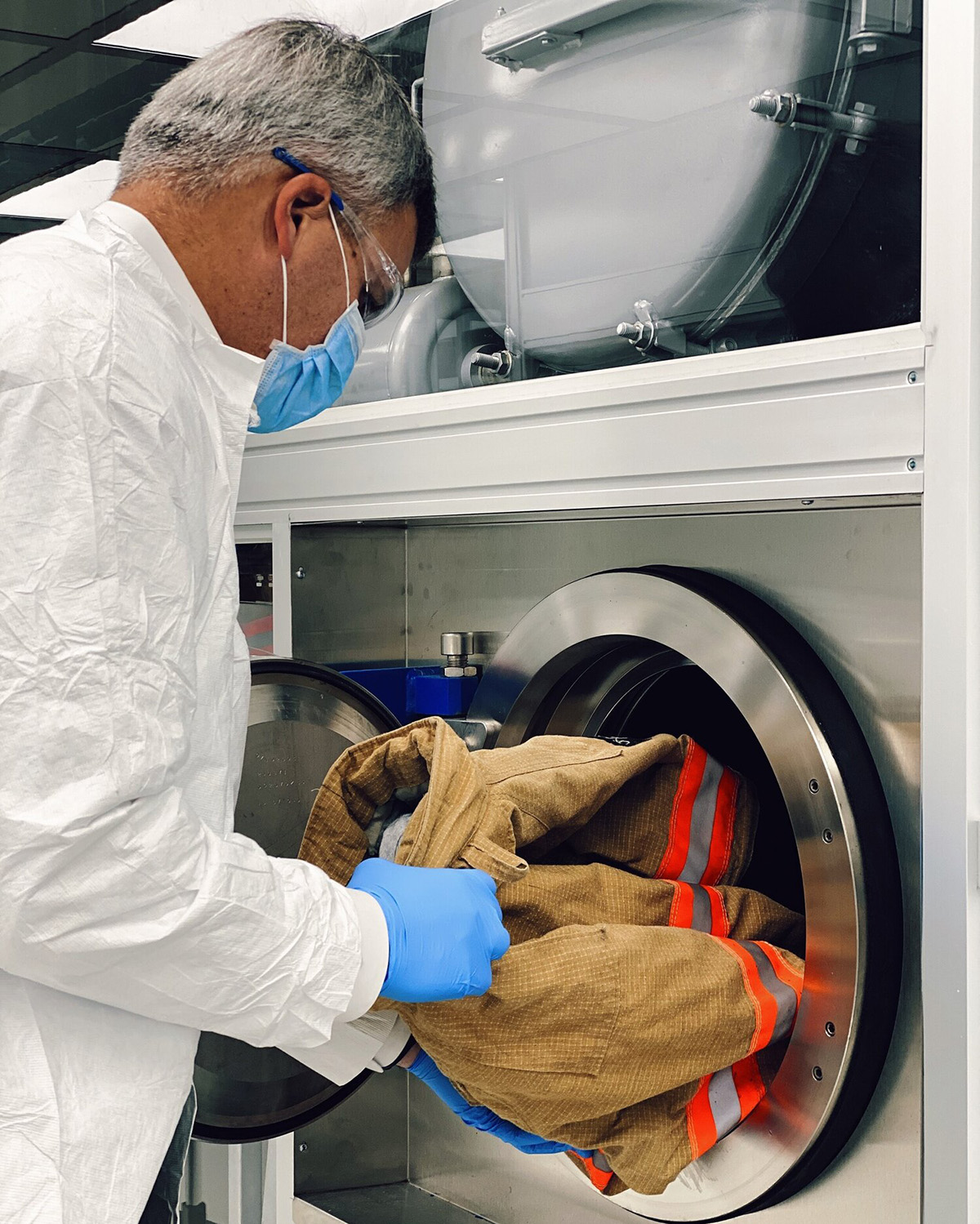
Just as important, departments are looking more closely at the full life cycle of PPE. Weight, contamination, drying time, maintenance, and wear all connect. That is part of why some departments evaluate Liquid CO2+ cleaning as part of a broader turnout gear care strategy focused on readiness, contaminant removal, and long-term gear management.
Firefighter gear will probably never feel light in the ordinary sense, nor should protective performance be treated casually. But understanding where the 45 to 75 pounds comes from gives departments a clearer way to train for it, manage it, and support firefighters who have to perform while carrying it.
If your department is reviewing how gear weight, contamination, and long-term PPE care affect readiness, is it time to take a closer look at your cleaning strategy? Request service today.