By: Mike Duyck, Senior Advisor
Selecting a PPE cleaning provider has never been more important. Today’s firefighters face exposure to an increasingly complex mix of carcinogens, PFAS, heavy metals, combustion byproducts, and other hazardous contaminants that can remain embedded in turnout gear long after an incident. While NFPA 1851 provides the framework for inspection, cleaning, repair, and retirement of firefighting PPE, not every cleaning provider delivers the same level of contaminant removal, documentation, or long-term protection.
For fire chiefs and decision-makers, choosing a provider should extend well beyond price or convenience. The right partner should help reduce occupational exposure, preserve the integrity of turnout gear, maintain compliance, and maximize the value of one of your department’s largest equipment investments.
The Limits of Traditional Water Washing
For years, water-based washer-extractors have served as the industry standard for cleaning turnout gear. While these systems effectively remove visible dirt, soot, and some surface contaminants, today’s fireground presents a different challenge.
Modern fires involve synthetic materials, lithium-ion batteries, engineered plastics, and countless petroleum-based products that release complex chemical mixtures when they burn. Many of these contaminants are hydrophobic, meaning they resist water and bond to the fibers within turnout gear. As a result, gear can appear clean while still harboring dangerous contaminants beneath the surface.
Research continues to show that firefighters are exposed to carcinogens through inhalation, ingestion, and dermal absorption. Even after laundering, certain contaminants may remain embedded within PPE, continuing to pose exposure risks every time firefighters wear their gear. The goal is no longer simply clean-looking gear. The goal is truly decontaminated gear.
Question 1: How does your cleaning media penetrate the moisture barrier without damaging the garment?
One of the biggest limitations of traditional water washing is simple physics. Water has relatively high surface tension, making it difficult to penetrate the microscopic spaces within turnout gear where oil-based contaminants often reside. Even when detergents are added, water primarily cleans the outer shell while leaving contaminants trapped deeper within the garment.
Ask your provider:
- What cleaning media do you use?
- How does it reach contaminants beneath the surface?
- How do you ensure the moisture barrier remains intact?
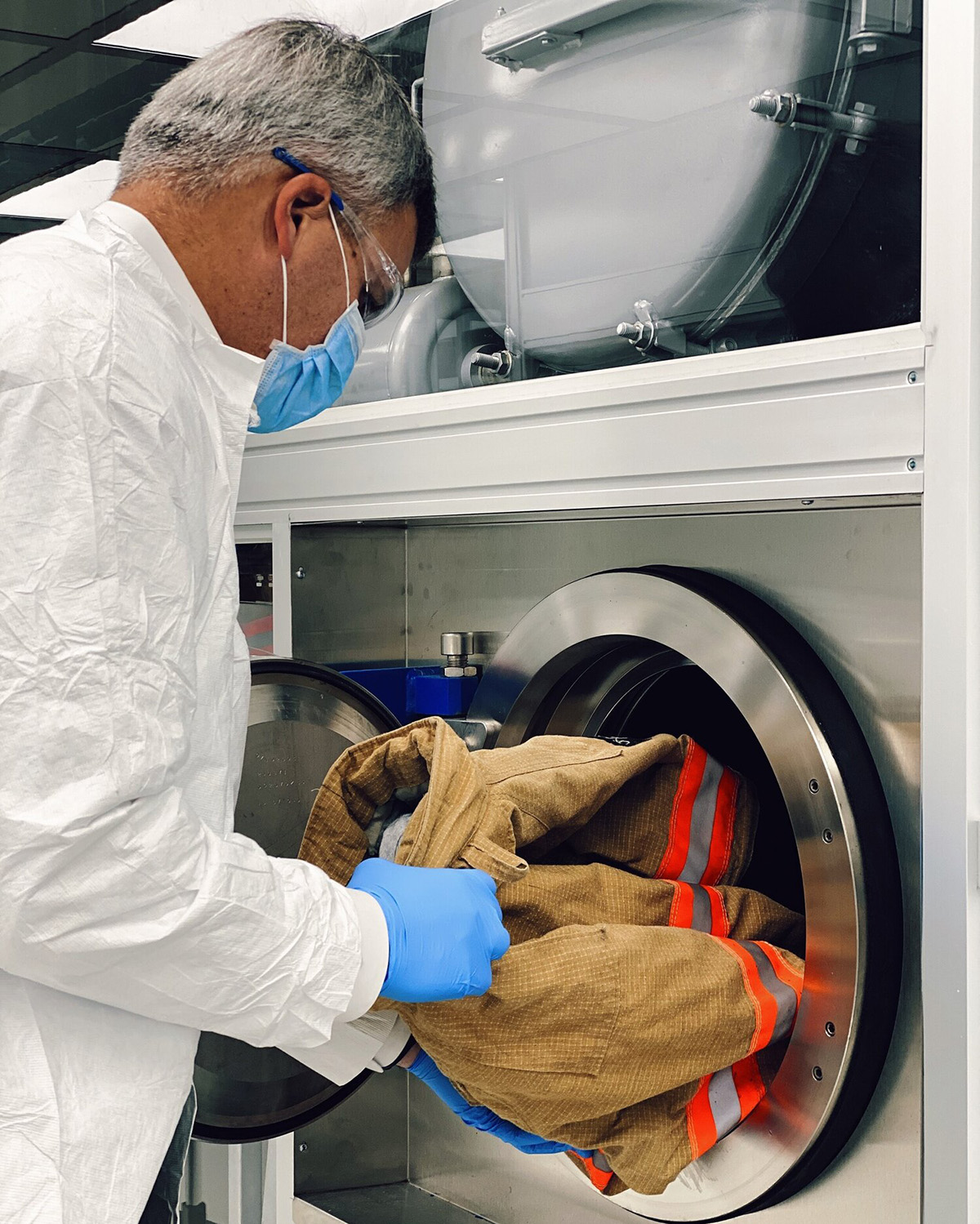
Advanced Liquid CO2+ cleaning works differently. Because liquid CO2 has extremely low viscosity and low surface tension, it can penetrate deep into turnout gear without soaking or damaging the moisture barrier. As it circulates through the garment, it dissolves and removes contaminants that conventional water washing may leave behind.
Just as importantly, the process avoids harsh detergents, excessive mechanical agitation, and prolonged heat exposure that can contribute to premature wear over time. When evaluating providers, understanding how contaminants are physically removed is just as important as knowing that the gear gets cleaned.
Question 2: What is your verified extraction rate for specific fireground carcinogens?
Every cleaning provider claims to clean gear. Few can demonstrate exactly what they’re removing.
Fire chiefs should ask for independently verified testing that measures removal rates for specific contaminants commonly encountered on today’s fireground, including:
- PFAS
- PAHs (polycyclic aromatic hydrocarbons)
- SVOCs (semi-volatile organic compounds)
- Petroleum-based residues
- Combustion byproducts
Traditional water washing often struggles to remove oil-based contaminants because water and oil naturally repel one another.
Emergency Technical Decon’s Liquid CO2+ cleaning has been independently proven to:
- Remove more than 84% of PFAS from turnout gear.
- Remove up to 99% of specific deep-layer contaminants to undetectable levels.
- Remove up to 100% of certain hazardous contaminants in validated laboratory testing.
These results provide departments with measurable evidence that contaminants are being removed, not simply redistributed. If a provider cannot provide verified laboratory data supporting their cleaning performance, chiefs should ask why.
Question 3: How do you guarantee zero cross-contamination between wash cycles?
Cross-contamination is an often-overlooked concern. Imagine heavily contaminated gear from a commercial structure fire being cleaned in the same washer immediately before another department’s PPE. Without proper cleaning of the cleaning system itself, residual contaminants can remain inside drums, plumbing, or water systems. This creates the possibility of transferring contaminants from one set of gear to another.
Ask your provider:
- How is the cleaning media purified after every load?
- What prevents contaminants from carrying over?
- Is the cleaning process truly isolated between departments?
Advanced closed-loop Liquid CO2+ systems continuously filter, distill, and convert the cleaning media back into gas during every cycle. This process separates contaminants from the CO2, captures them for proper disposal, and recycles clean Liquid CO2+ for the next load. Unlike conventional washer-extractors, the cleaning media itself is purified before it ever touches another garment. That means contaminants stay out of your gear instead of circulating through the next wash cycle.
Question 4: What does your NFPA 1851 third-party verification look like?
NFPA 1851 compliance is about much more than simply washing gear. Chiefs should verify that their provider maintains independent third-party certification demonstrating they meet the latest NFPA 1851 requirements.
Ask questions like:
- Are you independently verified by UL Solutions or Intertek?
- What services are included under your verification?
- Can you perform advanced inspections and repairs?
- Do you maintain digital maintenance histories for every garment?
A qualified provider should be capable of supporting the complete lifecycle of turnout gear through:
- Advanced cleaning
- Routine inspections
- Advanced inspections
- Repairs using OEM-approved materials
- Hydrostatic barrier testing
- Complete maintenance documentation
- Serialized garment tracking
Digital maintenance records are becoming increasingly important for liability protection, warranty compliance, and departmental audits. If documentation cannot be easily produced, departments may find themselves vulnerable during investigations or insurance claims.
Question 5: What is your real-world turnaround time, and how does it affect gear lifespan?
Cleaning quality matters. So does how quickly firefighters get their gear back. Long turnaround times can leave firefighters without primary PPE, forcing departments to rely on expensive reserve gear or purchase second sets simply to maintain operational readiness. Drying time is often one of the largest delays in traditional laundering.
Water-saturated gear requires lengthy drying cycles, increasing both downtime and wear. Liquid CO2+ cleaning eliminates this challenge. Because the Liquid CO2 naturally converts back into gas when pressure is released, turnout gear exits the cleaning chamber completely dry and ready for immediate inspection, packaging, and return.
The process also minimizes:
- Water saturation
- Fiber abrasion
- Mechanical agitation
- High-heat drying
Reducing these stressors helps preserve important performance characteristics such as Total Heat Loss (THL), thermal protection, moisture barrier integrity, and overall garment longevity. Over the life of a turnout ensemble, reducing unnecessary wear can significantly extend service life while lowering replacement costs.
Partnering with the Future of Decontamination
Firefighters deserve more than gear that simply looks clean. As research continues to reveal the health risks associated with persistent contaminants, departments are recognizing that traditional laundering alone may no longer provide the level of protection firefighters need. Advanced Liquid CO2+ decontamination represents the next evolution in firefighter PPE care by combining deep contaminant removal, closed-loop cleaning technology, rapid turnaround times, and NFPA 1851-compliant lifecycle management into one comprehensive solution.
At Emergency Technical Decon, every cleaning cycle is designed to do more than remove dirt. Our independently validated Liquid CO2+ process removes more than 84% of PFAS from turnout gear, eliminates up to 99% of specific deep-layer contaminants to undetectable levels, prevents cross-contamination through a closed-loop system, and helps preserve the integrity of your PPE for years to come. When choosing a PPE cleaning provider, don’t settle for claims. Ask the questions that protect your firefighters, safeguard your investment, and help reduce long-term occupational exposure.
Contact Emergency Technical Decon today to learn how our advanced Liquid CO2+ cleaning process can help your department build a safer, healthier PPE program.